
There are car races, there are classic car rallies, there are luxury automotive events, and then there is the Mille Miglia.
For the first time, I experienced the Mille Miglia in Tuscany, choosing the breathtaking setting of Siena as my stage. After reviewing luxury cars for more than ten years, across Europe and the UK, I can honestly say this was not just another car event. This was theatre. This was heritage. This was emotion on four wheels.
The Mille Miglia is often described as the most beautiful race in the world. Enzo Ferrari understood why. But standing in Siena, watching the classic cars arrive against the medieval drama of Piazza del Campo, I realised something even stronger.
This is not only the most beautiful race in the world.
It is the most spectacular lifestyle car event in the world.
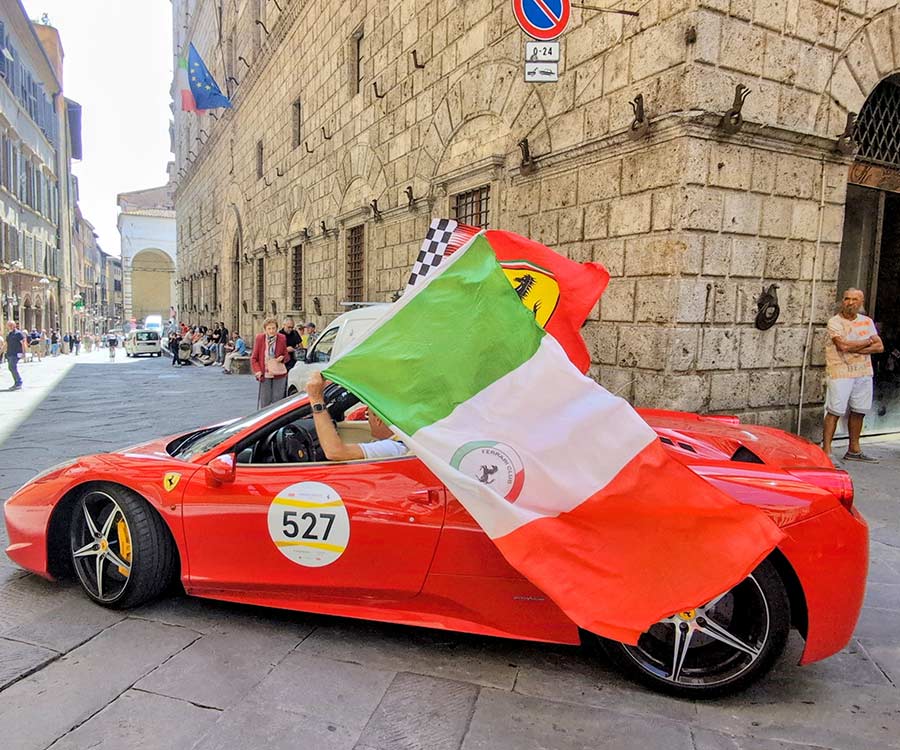
Siena Was The Perfect Stage
Siena is not a backdrop. Siena performs.
The terracotta tones, the ancient stone, the narrow streets, the grand shell of Piazza del Campo, the Italian flags, the heat, the crowds, the noise, the elegance — it all creates a kind of cinematic tension before the first car even arrives.
I have been to many luxury car launches and press events. I have sat inside modern supercars, reviewed Ferraris, Bentleys, Rolls-Royces, Aston Martins and electric luxury cars. I understand performance. I understand branding. I understand the theatre of automotive desire.
But nothing prepared me for seeing classic cars roll through Siena as if they belonged to the city itself.
That is the secret of the Mille Miglia. The cars do not arrive as museum pieces. They arrive alive. They breathe. They shake. They smell of oil, leather, heat and history. They do not need LED screens, launch music or artificial smoke. They carry their own drama.
In Italy, classic cars are not just machines. They are culture. They are family stories. They are memories. They are national pride. They are fashion. They are food. They are Sunday lunches, tailored linen, sunglasses, leather gloves, espresso bars, engines echoing through stone streets.
The Mille Miglia is called a race, but in Siena I saw something much more powerful.
I saw a lifestyle.
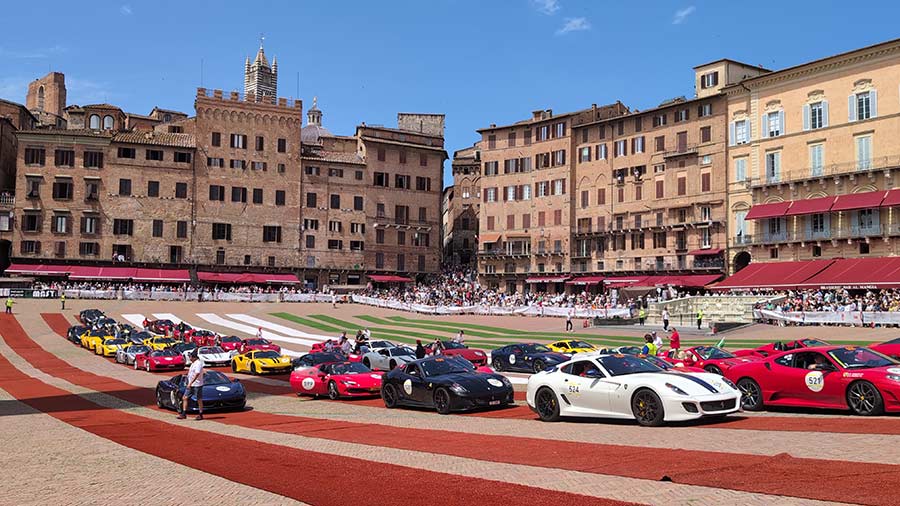
Not A Race, A Moving Museum Of Passion
The modern Mille Miglia is a regularity race for historic cars, not a flat-out speed race like the original event of the past. That matters, because it changes the atmosphere completely.
This is not about aggression. It is not about who can scream the loudest. It is not a modern race track full of barriers and corporate boxes.
It is a moving museum.
It is an open-air catwalk of automotive design.
It is Italy saying to the world: this is what beauty looks like when it is driven, not stored.
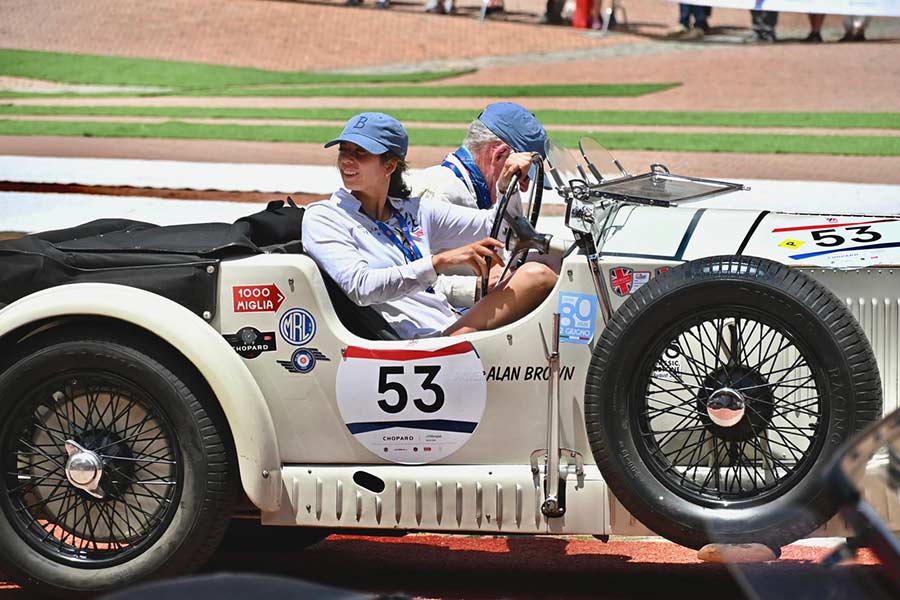
Every car had its own personality. Some arrived polished like jewellery. Others carried the marks of a life well lived. Alfa Romeo, Jaguar, Maserati, Porsche, Ferrari — each marque told a different story. Some cars looked like they should be parked outside a villa on Lake Como. Others looked ready to cross mountains and break hearts.
The sound was not just noise. It was history speaking.
There is something emotional about seeing cars from another era still being driven with purpose. So much of modern luxury is too perfect, too filtered, too controlled. The Mille Miglia is different. It allows imperfection. It celebrates patina. It lets the engine cough, the driver laugh, the crowd cheer, the child point, the woman wave from the passenger seat.
That is why I loved it.
Luxury today is not only about price. It is about soul.
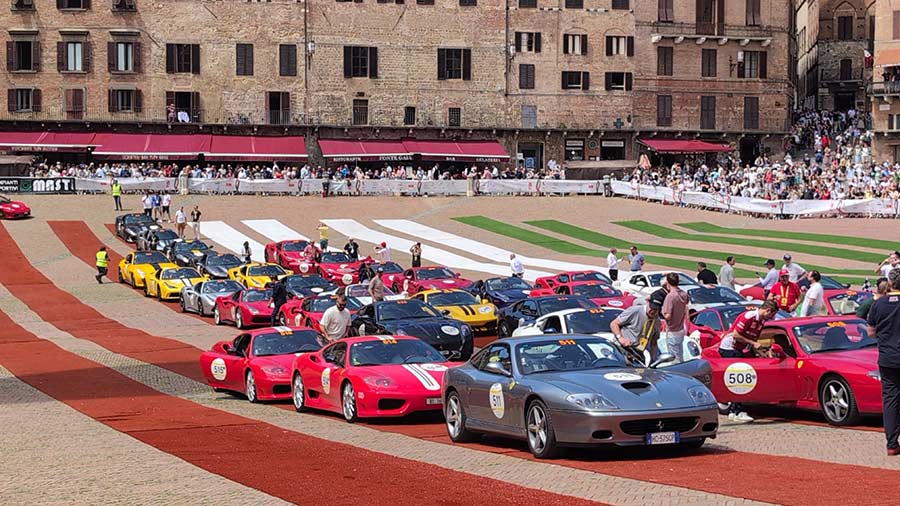
Ferrari, Emotion And Perfect Timing
The timing could not have been more perfect.
Only recently, Gracie Opulanza shared her thoughts on the new Ferrari Luce on Instagram, and the reaction was immediate. The post reached around 27,500 views and 66 shares, proving once again that Ferrari is not just a car brand. Ferrari is an emotional trigger.
People do not merely discuss Ferrari. They defend it. They argue about it. They fall in love with it. They question it. They dream about it.
And then, as if Italy itself wanted to answer the debate, Siena filled with classic Ferraris, modern Ferraris and the unmistakable aura of Maranello. The Ferrari Roma. The Purosangue. Cars Gracie has experienced before in the UK suddenly felt different in Tuscany.
Because Ferrari in Italy is not the same as Ferrari anywhere else.
In the UK, a Ferrari can feel like a status symbol. In Italy, it feels like part of the cultural landscape. It belongs to the food, the stone, the heat, the theatre, the gestures, the emotion.
Watching Ferraris arrive in Siena, surrounded by classic cars from different eras, made the debate around the Luce even more interesting. The question is no longer only whether Ferrari can make an electric car. The question is whether Ferrari can make an electric car that still makes people feel.
Because that is what Ferrari has always sold.
Not transport.
Not horsepower.
Emotion.
And at the Mille Miglia, emotion was everywhere.
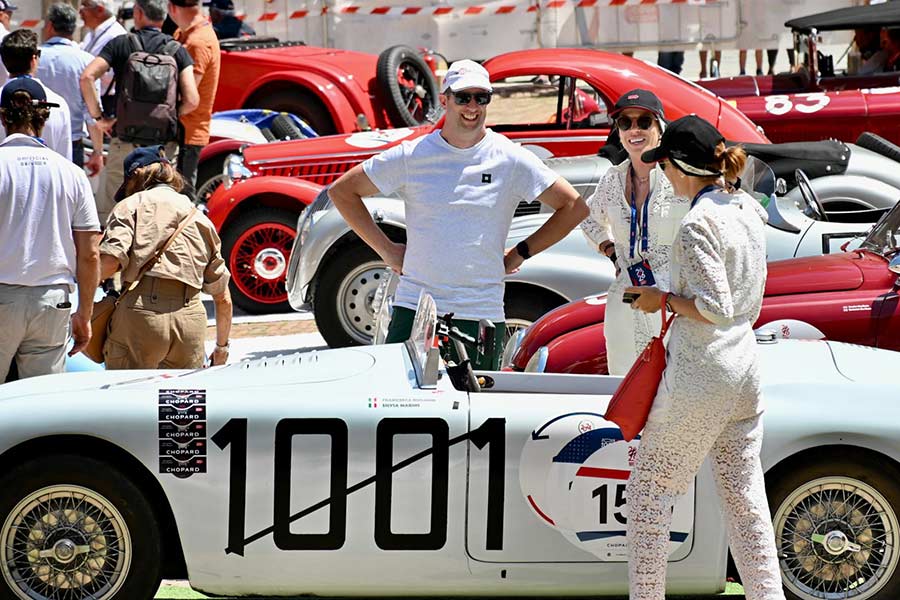
Women Behind The Wheel
One of the best parts of the day was seeing women driving.
For too long, the classic car world has been presented as a male playground. Men talking engines. Men holding keys. Men standing beside cars as if they alone understand them.
But in Siena, women were not accessories to the event. They were part of the story. Driving, navigating, waving, smiling, commanding these beautiful machines through one of the most spectacular city settings in Italy.
As a woman who has reviewed luxury cars for over ten years, Gracie knows how often the female perspective is ignored in automotive journalism. Too many reviews focus only on numbers: horsepower, torque, acceleration, engine size, top speed.
But women often experience cars differently. We notice the cabin. The seat. The smell of the leather. The colour. The design line. The emotion of arrival. The way people react. The lifestyle fit.
That is not superficial. That is branding.
That is why women matter so much in the luxury car world. We understand the full theatre of ownership. We know that a car is not just what it does on paper. It is how it makes you feel when you step out wearing the right shoes, the right sunglasses and the right attitude.
At the Mille Miglia, the women drivers proved exactly that.
They were elegant. They were brave. They were focused. They were stylish. They were part of the machine, not standing beside it.
That is the future of classic car storytelling.
Fashion Meets Engines
What makes the Mille Miglia unique is that it naturally blends cars with fashion.
At many automotive events, fashion feels forced. A brand invites influencers, places them next to a car and hopes glamour will appear. But at the Mille Miglia, style is already there.
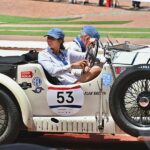
The drivers wear linen, caps, sunglasses, scarves and driving gloves. The passengers look like they have stepped out of an Italian film. The spectators dress for the occasion without being told. The cars themselves are fashion objects — sculpted, coloured, proportioned and finished with more elegance than most modern luxury products.
A classic car has a silhouette just like a dress.
A Ferrari red is as powerful as a couture gown.
A polished chrome grille catches the light like jewellery.
A leather bonnet strap is an accessory.
This is why the Mille Miglia is not just for petrolheads. It is for anyone who loves design, history, lifestyle and beauty. It is for people who understand that Italy does not separate these things. In Italy, a car can be engineering and fashion at the same time.
That is what I saw in Siena.
Not a race.
A rolling lifestyle runway.
Why The Mille Miglia Matters More Than Ever
In a world obsessed with electric cars, artificial intelligence, automation and silent mobility, the Mille Miglia feels more relevant than ever.
We are moving into a future where cars may become quieter, cleaner, smarter and more digital. That future is coming, and Ferrari’s Luce proves even the most emotional brands must face it.
But the Mille Miglia reminds us what cannot be lost.
Sound matters.
Smell matters.
Design matters.
Craft matters.
The relationship between human and machine matters.
When a classic car passes through Siena, people do not look down at their phones. They look up. They smile. They film, yes, but first they feel. Children wave. Older men remember. Women lean forward. Tourists stop walking. Locals come to windows. The city pauses.
That is power.
A modern car launch needs millions in marketing to create attention. The Mille Miglia needs an old engine, a brave driver and an Italian street.
That is why it remains unbeatable.
Tuscany And The Art Of Slowing Down
Tuscany is made for this event.
The rolling hills, cypress trees, stone villages, vineyard roads and medieval towns are not just scenery. They are part of the rhythm. The Mille Miglia through Tuscany feels like a love letter to slow travel, even when the cars themselves were born from speed.
There is something very Italian about that contradiction.
The original spirit was competition. The modern experience is appreciation.
You do not attend the Mille Miglia only to see who wins. You attend to witness beauty moving through beauty.
That is why Siena was such a perfect choice for a first experience. It gave me the full emotion in one place. The architecture, the crowd, the heat, the classic cars, the Ferraris, the women drivers, the fashion, the sound.
It was overwhelming in the best possible way.
The Gracie Opulanza Verdict
After more than ten years reviewing luxury cars, I have seen plenty of horsepower. I have seen luxury interiors. I have seen press launches, private previews, grand hotel arrivals, test drives and brand theatre.
But the Mille Miglia in Siena offered something different.
It offered authenticity.
It reminded me that cars are not only products. They are emotional objects. They tell us who we are, where we come from and what we still value.
The Mille Miglia is not trying to be modern, and that is why it feels so powerful. It does not need to chase trends. It is heritage in motion. It is Italy at full volume. It is a reminder that beauty, when preserved properly, never gets old.
The cars were spectacular.
The setting was unforgettable.
The fashion was effortless.
The Ferrari emotion was alive.
The women drivers inspired me.
And Siena gave the whole event a soul that no race track could ever match.
So yes, after my first Mille Miglia experience in Tuscany, I understand why it is called the most beautiful race in the world.
But for Gracie Opulanza, I would go further.
The Mille Miglia is the most spectacular lifestyle car race in the world.
Because in Italy, classic cars are never just cars.
They are passion.
They are theatre.
They are family.
They are fashion.
They are lifestyle.
And in Siena, for one unforgettable day, they became pure emotion.







You must be logged in to post a comment.