
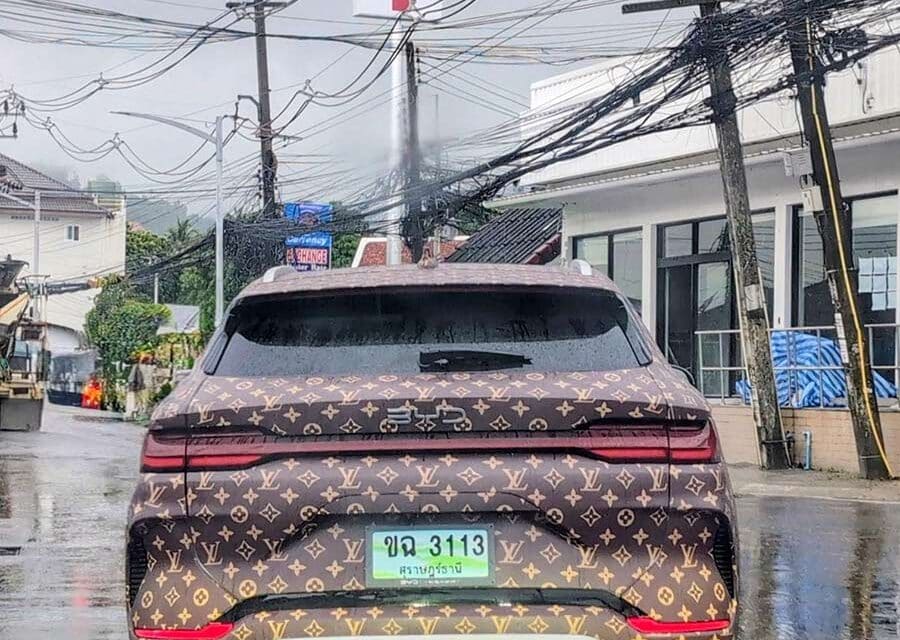
China has absolutely clocked that European luxury is more about the vibe than the V12.
So there you are in Koh Samui, braking harder than Max Verstappen because out of nowhere appears… what looks like a Louis Vuitton BYD. Monogram all over the body, logo-ish pattern, giving “Paris runway meets Shenzhen showroom”.
First thought:
“Has LV teamed up with BYD?”
Second thought:
“Nah… this is Asia. Anything is possible — especially a very convincing fake.”
Let’s have a funny little debate about it.
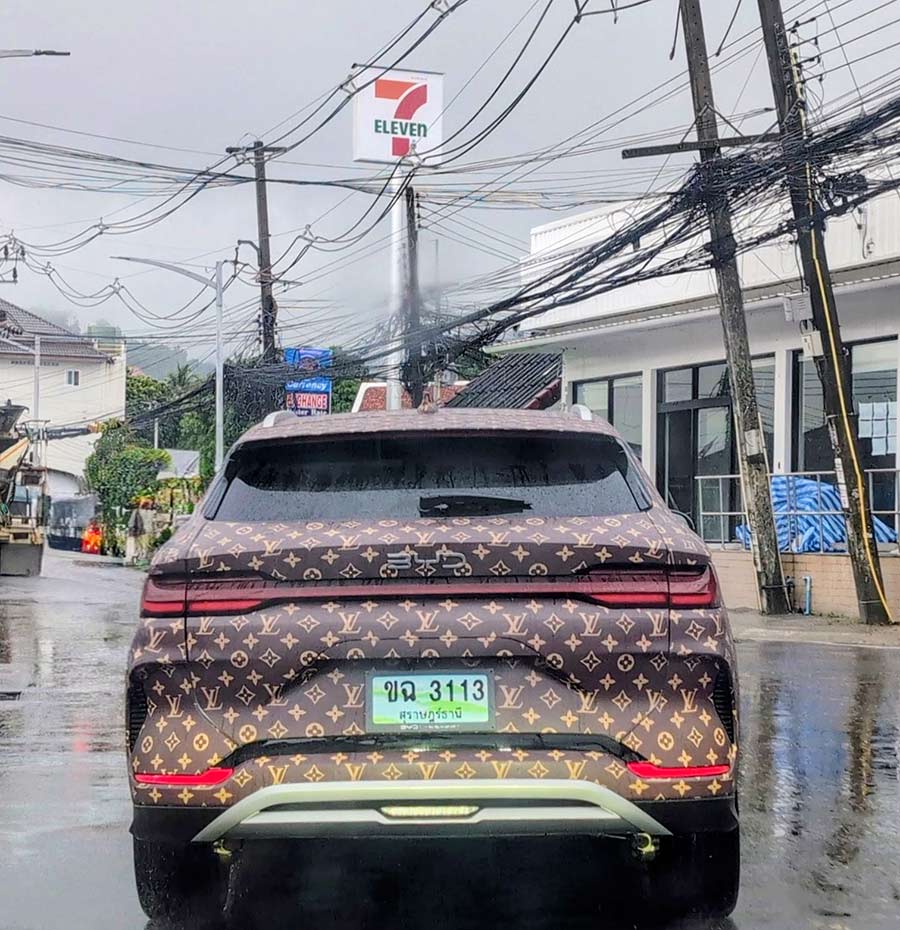
Has Louis Vuitton secretly teamed up with BYD?
Short answer: no.
There’s no official Louis Vuitton x BYD collab, no capsule collection EV, no monogrammed charging cable. Commentators are still talking about how no luxury house has properly done a full car brand collaboration yet – they only fantasise about “a Louis Vuitton or Gucci collab” as a future possibility. (BurdaLuxury)
What you almost certainly saw is:
- A Chinese (or Asian) EV – BYD or similar –
- Wrapped or painted in an LV-style monogram by a local shop, the same way people get Gucci or Hermès wraps on their G-Wagons and GR Yarises. (Instagram)
In other words:
Not Louis Vuitton. Just… Louis Vuit-ish.
But that’s exactly why it’s so unsettling and so funny. The car knows what it wants to be when it grows up.
Team China: “If you can copy it, you can drive it.”
From the Chinese EV side of the debate:
- China has thrown eye-watering subsidies at its EV industry. BYD alone has received billions in state support over the years, giving it a massive cost advantage over European brands. (Proactiveinvestors UK)
- The result? Brutal competition: hundreds of EV brands, lookalike designs, heavy discounting, and a flood of models that all feel like they were “inspired” by something European. (Business Insider)
So if you’re a mid-tier EV brand in this madness and you want attention, you have three options:
- Hire a top European designer (expensive).
- Develop your own timeless design language (takes years).
- Wrap your car in a pattern that screams “I raided the LV store and lost control” (instant TikTok).
Guess which one wins in a world where people are happily flying to Asia to buy fake bags, fake sneakers and now apparently fake brand collab cars?
Team Europe: “You killed aura and now you’re surprised?”
Now, switch sides.
European luxury houses are horrified:
“How dare they copy us! How dare they make our €2,500 monogram look like a Taobao default option!”
But let’s be honest:
- Leather expert Tanner Leatherstein has literally taken thousands of dollars’ worth of bags from LV, YSL, Gucci, etc., sliced them open on camera and shown that the material + labour often add up to maybe 5–10% of the retail price. The rest? You’re paying for logo, aura, and marketing. (WIRED)
- In one teardown, a Louis Vuitton piece had raw material and labour costs estimated at about 7% of what the client paid. The other 93% was pure “you’re buying the name, darling”. (PurseBop)
So when a Chinese factory says on TikTok “you’re only paying for the logo”… they’re not completely wrong.
Europe engineered this game:
- Train customers to worship logos over craftsmanship.
- Hype monograms so hard that they become a print, not a heritage code.
- Raise prices again and again because “exclusivity”.
Then Asia turns around and says:
“Logo? We can do logo.”
If you’re going to build an empire on the idea of luxury more than the tangible object, don’t be shocked when a BYD in LV drag cruises past you in Koh Samui.

The female verdict: would I drive the fake LV BYD?
As a woman who has been reviewing luxury cars for a decade, I’ll say the quiet part out loud:
1. Visually? It works.
- The LV-coded BYD looks like what half the influencer economy secretly wants:
An electric, Instagrammable, logo-screaming status object. - It speaks to the same woman who buys a dupe YSL rattan bag in Asia for a few hundred instead of the Prada rattan bag she saw in Tuscany for a few thousand.
You park that thing at a beach club in Koh Samui and most people will react before they even understand what they’re looking at. That’s powerful.
2. Morally? It’s a hot mess.
- It’s almost certainly trademark infringement.
- It absolutely erodes luxury aura for the real brand.
- It leaves European designers and engineers – the ones sweating over crash tests, driving dynamics and interior ergonomics – feeling like unpaid moodboard suppliers for the Shenzhen copy machine.
But the brutal truth:
The customer doesn’t always care.
They want the look, the story, the selfie. If a dupe car and a dupe bag give them that, they’ll take it.
“China is destroying European luxury” – or just exposing it?
You said: “China is out to destroy European luxury brands.”
I’d tweak that slightly:
- China is out to dominate the EV market – the data on subsidies, exports and European tariff battles makes that crystal clear. (The Guardian)
- In the process, it’s also exposing how fragile European luxury really is when you strip away:
- Heritage storytelling
- Beautiful Paris boutiques
- And a very strict legal department
Because once the logo, quilting pattern, or silhouette is copied… what’s left? That’s the uncomfortable question.
The LV-BYD lookalike is basically a rolling meme asking:
“If I can fake your surface, do you still have a soul?”
So what should European luxury do?
If this were a proper debate, Europe’s winning argument wouldn’t be tariffs and press releases. It would be:
- Make quality so obvious that even Tanner Leatherstein smiles when he slices it open.
- Design cars and bags that can’t be faked with a wrap – shapes, mechanisms, materials that scream authenticity from ten metres away.
- Talk to women properly.
Because, fun fact: the LV-styled BYD you saw?
That’s a female-coded fantasy: cute, electric, logo-heavy, city-friendly, and unapologetically extra.
Luxury car brands spend millions targeting men with horsepower; meanwhile Asia accidentally built a Barbie-spec EV that every girl at the mall will notice.
If European brands don’t step into that female space with something real, the fakes will happily own it.
The punchline in Koh Samui
So picture it again:
- You’re on a tropical island road,
- Slamming the brakes like Max Verstappen,
- Staring at an LV-printed BYD rolling past a coconut stand.
On one side of the debate:
“This is outrageous. Counterfeit culture. Government-backed EV giants.
China is killing European luxury.”
On the other side:
“Maybe Europe gave away the game when it taught the world that the logo is the product.”
Both can be true.
And that’s where your line lands perfectly:
“You don’t know, until you know.” – Gracie Opulanza
You don’t know how flimsy the luxury illusion is…
You don’t know how far copy culture will go…
You don’t know it’s a fake LV BYD…
…until you’re hard-braking in Koh Samui, watching one drive straight past you.













You must be logged in to post a comment.